

Learn About Third-Party Assisted Reproduction & Surrogacy Law in Maryland
Everything you need to know about fertility law in Maryland, including surrogacy.
Reviewed for legal accuracy by Klein Fertility Law
Disclaimer: This content is for informational purposes only and does not constitute legal advice. Klein Fertility Law provides guidance tailored to your unique circumstances, and you should always consult with qualified legal counsel
Key Legal Requirements in Maryland
- Maryland does not have a governing surrogacy statute; however, case law has established the legality of gestational surrogacy in the state. Key legal considerations include: Compensated gestational surrogacy is permitted
- All parties should enter into a written Gestational Surrogacy Agreement prior to cycle medication
- Independent legal counsel for all parties is strongly recommended to navigate the legal landscape effectively. Court involvement is required to secure a parentage order. Parentage is typically established through a pre-birth legal process, although Maryland courts will recognize post-birth order, if a pre-birth order was not obtained
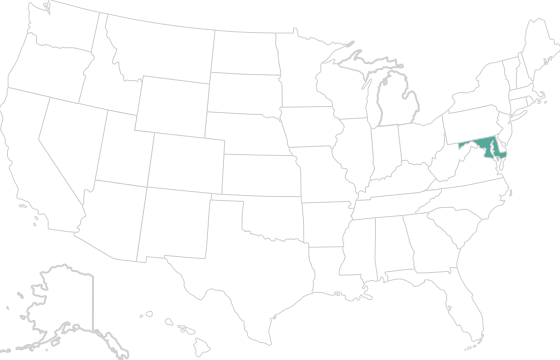
Maryland Surrogacy Law: What You Need to Know
Maryland permits surrogacy for married and unmarried couples, same-sex couples, and single parents. With a properly executed Gestational Surrogacy Agreement and attorney guidance, intended parents can expect the issuance of parentage orders, them as legal parents.
Maryland Surrogacy at a Glance | Compensated Gestational Surrogacy | Allowed |
|---|---|
| Same-Sex Couples | Allowed |
| Single Parents | Allowed |
| Married Intended Parents | Allowed |
| Unmarried Intended Parents | Allowed - Official marriage typically simplifies the legal process to establish parentage |
| Pre-Birth Parentage Orders | Allowed |
| Gestational Surrogacy | Permitted |
| Traditional Surrogacy | Permitted provided the surrogate does not receive compensation, but more legally complex and less common |
| Surrogacy Agreement | All parties should enter into a Gestational Surrogacy Agreement prior to cycle medication |
| Legal Representation | Independent legal representation for each party is strongly recommended |
| Health Insurance for Surrogates | Surrogates should have health insurance coverage for a surrogate pregnancy, addressed in the gestational surrogacy agreement |
| Parental Rights for Non-Genetic Intended Parents | Allowed |
| Eligibility for International Intended Parents | Allowed, but requires additional steps depending on the laws of their home country |
| Court Involvement | Required for parentage orders |
| Birth Certificate | An expedited birth certificate is typically available within 5 days A non-expedited birth certificate is typically available within 1 month |
| Post-Birth Timeframe to travel home | Domestic: Immediately International: 2-4 weeks post-birth |
Surrogacy laws can be complex and may vary depending on specific circumstances. It's crucial to consult with an attorney for personalized advice.